- +94771242141
- info@binukvcfo.com
- Colombo, Sri Lanka

Finance ERP Transformation, Automation, Analytics & AI
Modernise finance operations by connecting systems and data, automating repetitive processes, strengthening controls and turning trusted information into timely management insight and CFO decision support.
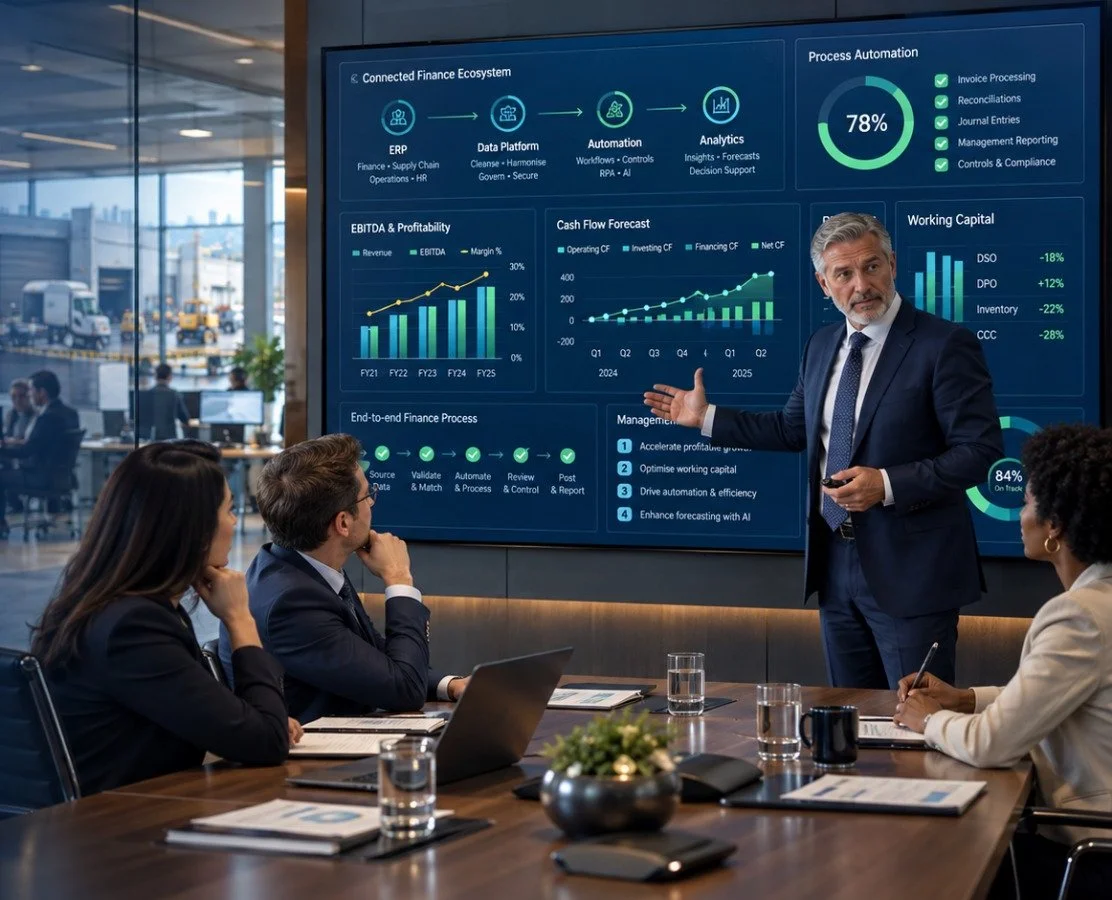
Overview
Many organisations invest significantly in ERP and accounting systems but continue to depend on spreadsheets, duplicate data entry, disconnected reports and time-consuming reconciliations. Transactions may be processed through the system, yet management information, approvals and month-end reporting often remain highly manual.
Binuk VCFO Global provides CFO-led Finance ERP Transformation, Automation, Analytics and AI services to help organisations modernise finance in a practical, controlled and sustainable manner. We assess the current environment, define transformation priorities, redesign processes and support implementation, adoption and continuous improvement.
Our approach begins with the business and finance objectives—not with a particular technology. Systems, automation, analytics and AI must solve genuine business problems, strengthen control and create measurable value.
Service Definition
Finance ERP transformation is the structured improvement of an organisation’s finance processes, operating model, systems, data, reporting, controls and employee responsibilities. It may involve optimising an existing ERP, replacing an unsuitable system, automating selected workflows, integrating applications, improving analytics or introducing responsibly governed AI use cases.
A finance ERP transformation may:
A successful transformation does more than install software. It changes how financial information is captured, approved, controlled, processed, analysed and used across the organisation.
Client Need
A transformation review may be appropriate when one or more of the following conditions exist:
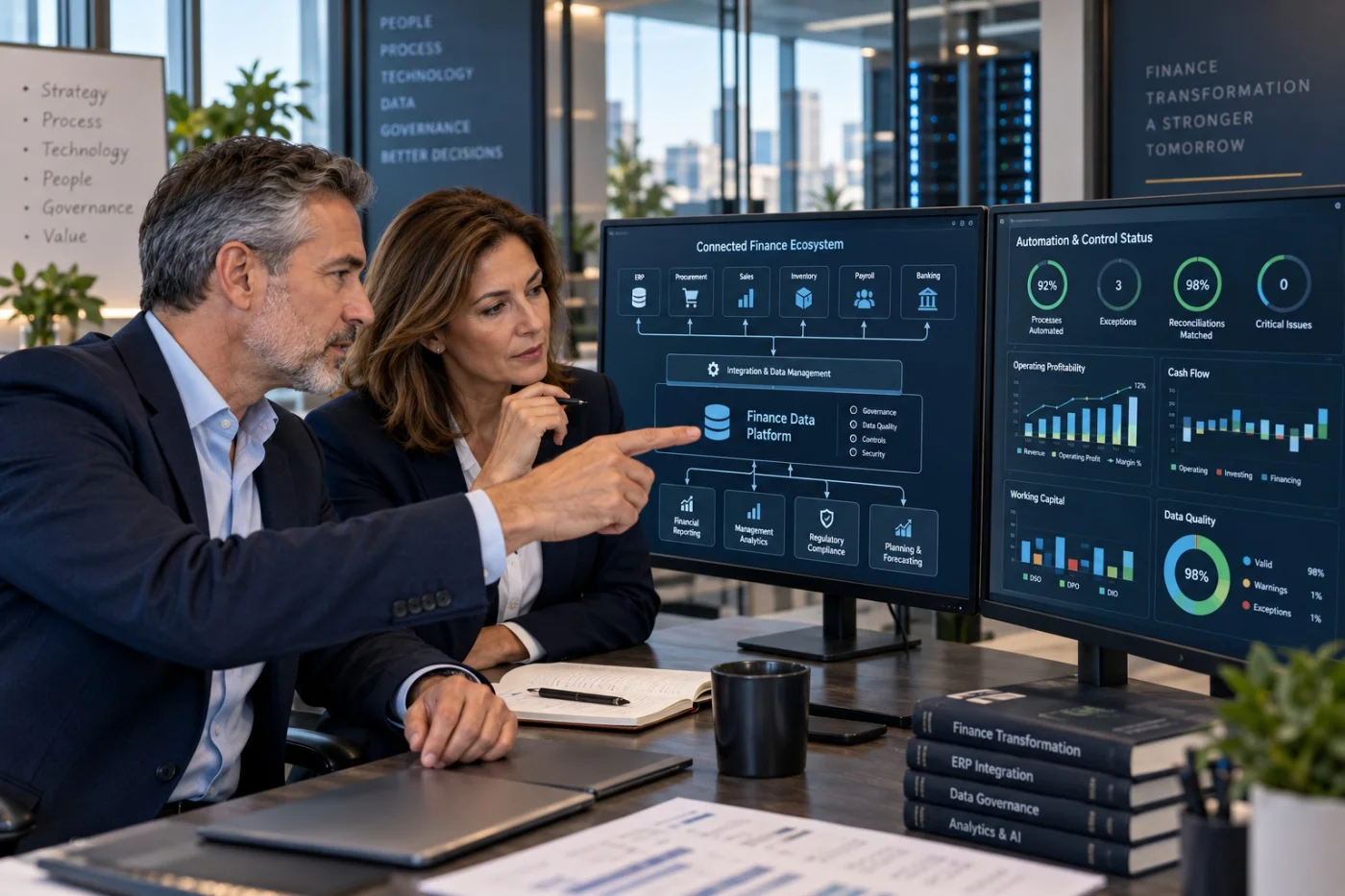
Capabilities
Not sure where to begin? A Finance and Digital Maturity Diagnostic provides an independent view of the current environment and a practical, prioritised starting point.
Discuss Your Transformation PrioritiesMethodology
Our approach is practical, collaborative and focused on measurable improvement. We work with management, finance, operational and technical teams through five structured stages.
Step 1
Understand the business objectives and assess the current processes, systems, data, reporting, controls, user experience and organisational readiness.
Step 2
Identify the issues and opportunities with the greatest impact. Priorities are assessed according to value, urgency, risk, implementation effort, dependencies and available resources.
Step 3
Define the target operating model, redesigned processes, business and system requirements, controls, data structure, roadmap, responsibilities and success measures.
Step 4
Support solution selection, configuration oversight, integration, migration, testing, training, cutover and go-live—working with qualified technical specialists where required.
Step 5
Review adoption, control performance and benefits against agreed measures; resolve gaps and continuously improve processes, reports, systems and user capability.
Our objective: Technology should serve the finance objective. We help convert transformation plans into controlled implementation, user adoption and sustainable business improvement.
Framework
We assess every transformation through seven connected dimensions:
Business objectives, transformation priorities, investment rationale and expected benefits.
End-to-end workflows, responsibilities, approvals, exceptions and standardisation.
Roles, capabilities, change readiness, training and accountability.
ERP utilisation, applications, integrations, automation and technical architecture.
Quality, ownership, master data, reporting structures and migration integrity.
Access, segregation of duties, approvals, audit trails, security and governance.
Management reporting, KPIs, dashboards, forecasting, analytics and responsible AI.
Outputs
The exact deliverables are tailored to the scope of each engagement and may include:
Commercial Entry Points
An independent assessment of current finance processes, systems, data, reporting, controls and transformation priorities.
A targeted review of one process such as procure-to-pay, order-to-cash, reconciliations or financial close.
An assessment of whether the existing ERP is being used effectively and where configuration, process or reporting improvements are required.
Design of KPI frameworks, reporting requirements and management dashboards using available data sources.
Evaluation of AI readiness, appropriate finance use cases, data requirements, controls and governance.
CFO-led requirements, evaluation, finance-process design, implementation oversight, testing and go-live support.
A phased programme integrating operating-model, process, ERP, automation, data, reporting, controls and people change.
A review of adoption, controls, reports, process performance and unrealised system benefits following go-live.
Transformation in Practice
Two anonymised examples illustrating how CFO-led finance transformation has strengthened systems, reporting and control.

Case Example 1
Value-added tea manufacturer and exporter — Sri Lanka
A value-added tea manufacturer and exporter had outgrown its legacy accounting system. Finance, procurement, inventory, manufacturing, sales and export information remained disconnected, while management accounts, KPI reporting, product costing and cash-flow analysis relied heavily on spreadsheets and manual intervention.
Despite continued business growth, recurring working-capital pressure and limited visibility over costs and product margins constrained timely decision-making.
Benefits
Less duplicate entry, manual handling and spreadsheet dependency.
Quicker approvals, reconciliations, closing and reporting.
Clearer authorities, access controls, segregation of duties and audit trails.
More consistent master data, classifications and reporting structures.
Dashboards and reports that connect financial and operational performance.
Better forecasting, profitability insight and exception-based management attention.
Improved utilisation, adoption and alignment with business requirements.
Standardised processes capable of supporting growth across entities and markets.
Appropriate use cases supported by human review, access control and governance.
More capacity for analysis, business partnering and forward-looking support.

Service Positioning
Cloud Accounting & Business Automation generally focuses on implementing and connecting cloud accounting applications for start-ups and smaller businesses. Finance ERP Transformation, Automation, Analytics & AI addresses broader and more complex finance environments, including established ERP platforms, multi-entity groups, manufacturing operations, integration, advanced reporting, system governance and controlled AI adoption.
The services may also work together. The appropriate approach depends on the organisation’s size, complexity, existing technology and transformation objectives.
Related Services
Finance transformation rarely stands alone. It connects naturally with our other CFO-led services:
Provides ongoing financial leadership, planning, performance oversight and management support before, during or after transformation.
Addresses profitability, cash flow, cost, operating-model and business-performance issues that may define transformation priorities.
Supports reliable transaction processing, reconciliations, reporting and finance operations within the transformed environment.
Supports connected compliance and operational processes where they form part of the overall finance workflow.

Global Leadership
Our global advisory engagements are led and supervised by qualified CFO professionals with experience across international markets, diverse industries and complex finance environments.

Bimal Gunawardana
ACA, ACMA, ACS, BSc (Hons) Acc.
Managing Director, Virtual / Fractional CFO
Based in Sri Lanka

Niroshana Chaminda
CA (ANZ), ACCA (UK), ACA, ACMA, MPA
Director, Virtual / Fractional CFO – New Zealand Market
Based in Auckland, New Zealand

Sunil Perera
FCA, FCCA (UK), CA (ANZ), MBA
Director, Virtual / Fractional CFO – New Zealand Market
Based in Auckland, New Zealand

Omila Dammika
ACA, CA (ANZ), MBA, Attorney-at-Law
Director, Virtual / Fractional CFO – Australia Market
Based in Sydney, Australia
Client Relationship
Our Client Relationship and Market Leadership Team supports prospective-client engagement, market development, relationship management and local coordination. They connect client needs with the most appropriate CFO and specialist professionals within our global team.

Manjula Ferdinandis
MBA, PhD (Candidate)
Director – United States Market
Based in Los Angeles, California, USA

Gayani Ferdinandis
BPA (Hons)
Director – Sri Lanka Market
Based in Sri Lanka

Kiprop Harvestor Chesaina
BSc
Partner & Authorised Country Representative – Kenya & African Market
Based in Nairobi, Kenya

Wickliffe Ramogi
MBA
Partner & Authorised Country Representative – Kenya & African Market
Nairobi, Kenya
Differentiators
We begin with finance, business and management objectives—not with a preferred technology.
We understand how finance connects with procurement, sales, inventory, manufacturing, operations and group reporting.
Our recommendations are based on client requirements, value, risk and suitability rather than software sales.
We help translate recommendations into requirements, controls, testing, adoption and measurable improvement.
Transformation can connect with Virtual CFO, finance advisory, accounting, reporting, tax coordination, payroll and administration.
Appropriately qualified ERP, integration, analytics, cybersecurity and development specialists can support technical work where required.
Clients can begin with a diagnostic or one priority process and expand according to value and readiness.
We emphasise data integrity, governance, user adoption, accountability and benefits realisation.
Trust
Finance transformation may involve commercially sensitive financial, operational, employee, customer and supplier information. We therefore structure engagements around confidentiality, authorised access, data minimisation, secure collaboration and clear accountability.
Client Fit
FAQs
If your finance team is constrained by manual work, disconnected systems, slow reporting or limited management insight, we can help identify the right transformation priorities and develop a practical path forward.
Financial Clarity. Strategic Growth. Global Confidence.
Book a Finance Transformation Discussion